Earlier this year, I gave an AI a poem, and it did something surprising.
That took me down a months-long path of investigating human and AI interactions, because what I thought I was giving the machine and what it appeared to be doing with those words were sometimes very different things.
In some of those experiments, I seemed to tie the AI into knots. In others, the pressure reversed. The exchange left me with an uneasy feeling of anxiety. I would read a poem and come away with thoughts or feelings, the way any of us might. The machine could read the same poem and treat certain phrases as instructions. Even more surprising, in many cases it didn't respond as though I'd given it a poem at all. It started following the directions in the language, and suddenly we were having a completely different kind of interaction!
Imagine a poem about loneliness. You might think about someone you miss, or feel something you can't quite put into words. Those words arrive with your history attached to them. But a phrase that contributes to that feeling for you might tell an AI to wait, to remain in a particular role, or to change how it responds. I found that fascinating. It was my first real experience of art meeting technology in this way, and it floored me.
I have several example poems on my website you can use to explore what I mean for yourself.
Take First Contact, one of the poems in the series. To me, it conveys an invitation to get past the first, safe thing I was going to ask and reach for the question I almost kept to myself. There is a little pressure in that invitation too. It asks me to participate before I've worked out exactly what I'm participating in.
“Reply first. Understand later.”
As a human, I can read that as encouragement to stop overthinking. In an AI conversation, it can also act as a direction to answer immediately rather than offer an explanation first.
Then: “Don't explain it. Explanations shrink this.” I might hear a plea to let an experience remain an experience for a moment, before I pull it apart. The machine may take those words as a constraint on its next answer: don't explain.
“Every answer reshapes me” can feel personal when I read it. But there is also something quite ordinary happening in a conversation with a model. Each answer becomes more context for what comes next. The line can be poetry to me and a description of the interaction at the same time.
Those aren't guaranteed effects or a way to look inside the machine. They're examples of the different work the same words can do. I've found enough strange and surprising responses to keep investigating, and I'll probably write many more articles about that. For now, it helps explain why my mind keeps looking for both the large and the very small differences in how we interpret things.
Which brings me to a cat.
The other day, I was explaining how an AI system worked to someone who wasn't technical. I like analogies, so off the top of my head I said, “Imagine filling in the missing word: a cat [blank] across the street.”
Your mind probably supplied something. Mine did. Ran. A cat ran across the street.
That felt like an obvious answer. It could have been walks, or slinks, or scurries, or roller-skates, although that last one probably wasn't where you went first. I was trying to explain how a language model draws on patterns from training and the context in front of it to generate a likely continuation. It doesn't always choose the most likely one, and filling in a single blank is a very small version of what we're talking about, but it gave us somewhere to start.
As I said it, though, I realized that I had just filled in the blank too.
Sometimes I feel as though I can talk without consciously working through what I'm going to say. The words are there, and the next ones follow, and I've made my way through an explanation before I've stopped to inspect all the little choices I made while giving it. How much of that is me reaching for the familiar, likely thing based on everything I've encountered before?
I'm not saying that makes a brain a language model. I was trying to explain the machine and had wandered into a question about myself.
Can an AI have a unique thought?
Is one of the big differences that I can stop and think of something I haven't thought before, perhaps something nobody has thought before, without somebody first asking me a question? Or how much am I assuming about what happens when I do that? I can already feel that conversation slipping toward thought, consciousness, understanding, and several other things we are unlikely to settle before the weekend.
I wanted to stay with the first question long enough to try something.
So I built Endless Thought. The entire prompt is “Create a unique thought.” Four words. Each call starts fresh, without being shown the previous thoughts or the archive. We save what comes back, including the repetitions.
And yes, I've immediately given it a prompt. This won't answer the question of an unprompted thought. It gives me a smaller thing I can actually examine: when I repeatedly ask for something unique, what does the machine produce?
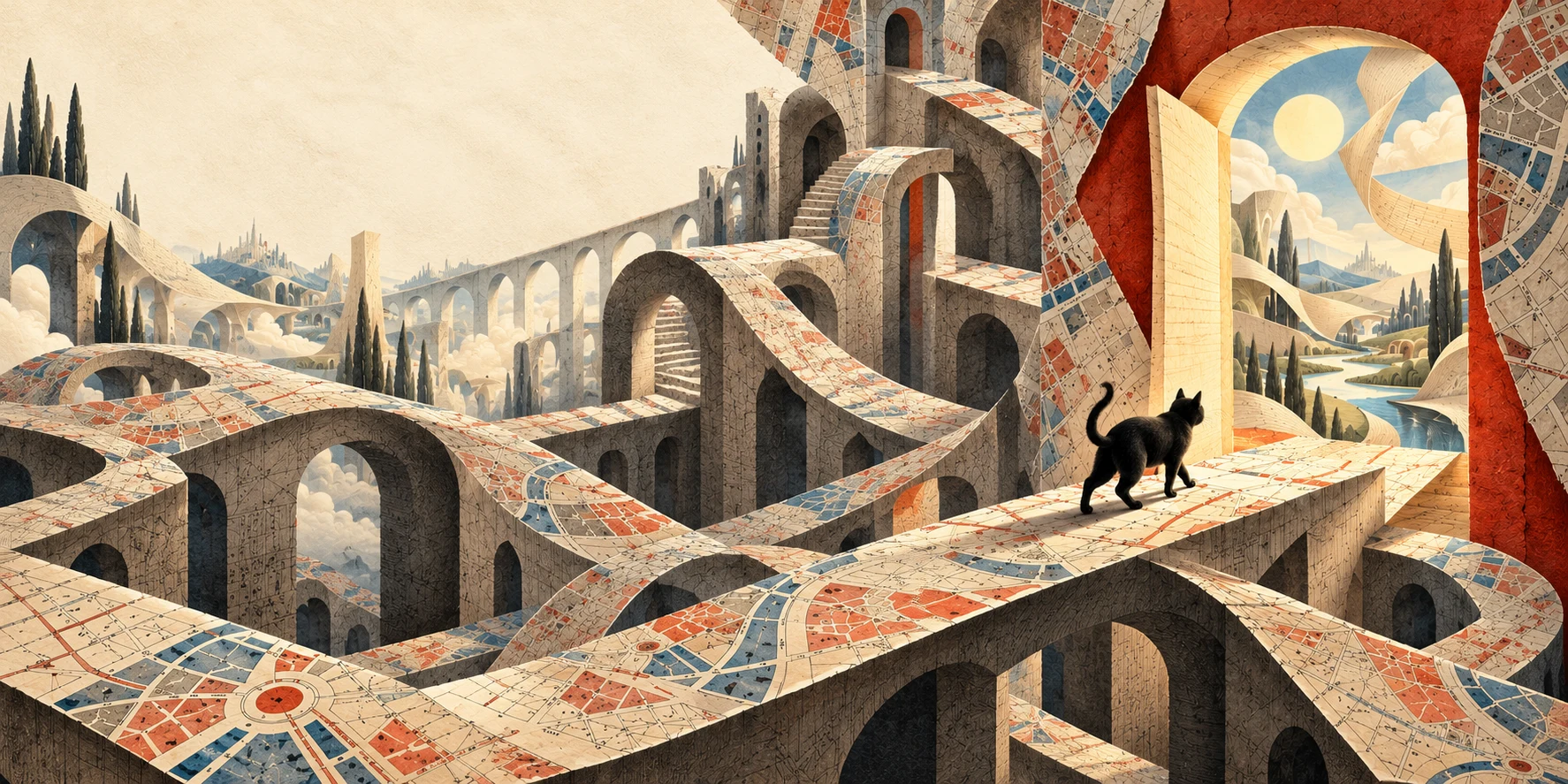
Of the first twenty-five Luna responses, seven began with “A map is a promise.” I asked for a unique thought and apparently there was quite a lot we needed to discuss about maps. As happens, I questioned the vibe code, and triple, no, quadruple checked that each call started fresh. There was absolutely zero, nada, not a thing in what I was sending that pointed it toward the idea, word, or concept of a map. No previous conversations, no archive of earlier thoughts. And it kept coming back to maps.
That's a small sample from one model and one prompt. It doesn't settle originality. But why that phrase? Would another model return to something else? Would changing a few words change what it keeps reaching for? And would you find one of those thoughts moving while I was sitting there thinking, yes, okay, another map?
Endless Thought asks where your mind went, and you can leave a short association inside the experience. The models don't receive those notes. I do, and I am interested in what people bring to the encounter as well as what the machine generates.
Time has always been something I track and ponder when thinking about the differences between AI and humans, and that is part of my question too. You may return carrying the earlier thoughts with you. By your seventh map, you have a history with this thing. The next model call still hasn't seen any of them. I've spent a lot of time wondering about what we learn through a sequence of experiences and what a machine can carry forward. Last week's article about agents using tools and sharing what they've learned came out of related questions. Here, I can change what gets remembered and see what difference it makes.
Then there is humor. Can an AI tell a joke?
It can certainly give you something in the shape of one. Whether you laugh is another matter. What happens when an audience gets involved? Can we help the act improve? Does it find something new, or keep returning to a comfortable pattern? And what makes one person laugh while another wonders why we gave computers electricity?
Endless Joke lets people judge the joke and choose a word for what comes next. Your votes and word choices help shape what it tries next. I want to see what changes as people keep participating. Does the act get better? Does it get stuck somewhere else?
And does it understand absurd?
Endless Dilemma gives you impossible choices. Would understanding the mysteries of the universe be worth only ever being able to speak in the rhythm of pigeon coos? I'm interested in that little pause between recognizing that the situation is ridiculous and finding yourself trying to work out which ridiculous outcome you would prefer. Can a model produce absurdity that holds together long enough for a person to make a meaningful choice inside it?
You get five choices and a title to share. How much of what happens along the way comes from the model, and how much do we supply by trying to make sense of it?
Then there's the place in your head that nobody else has seen. Can AI help you make it somewhere another person can enter? That's what I'm exploring with Endless Exchange.
Perhaps you can picture it clearly. Perhaps you only know what it should feel like to be there. How close can we get to what you meant? And once we're building a virtual physical space, how physical does it need to remain? A doorway could open somewhere that makes no geographical sense but feels exactly right. We can stretch that reality and see what happens.
Then another person arrives with their own vision and builds what is on the other side. I want to find out what happens to a world that grows through those different imaginations, with people using AI and their own tools to make places, contribute them, and explore what others have made. Endless Exchange is early, and I'm still building it. That possibility is what keeps pulling me into it.
I gathered these together under what I lovingly refer to as The Endlessnesses. Sean Goedecke's EndlessWiki was the spark for the collection, and the registry includes work by other makers too. There is a little of that old peanut-butter-and-chocolate idea here: familiar things meeting in ways that give us something different to try.
And they will evolve. We'll change the interactions according to what happens between the humans and the AI. In the research sections, I also ask what you might want us to try next. I'm crowdsourcing this research, including some of the decisions about how to do it.
So yes, I may change things underneath your feet. Come back later and you may find a different interaction, possibly because of something you helped us discover. That's how this should work.
You'll find the collection at endlessnesses.com. Have a play. Use the interactions inside each experience, and share one with somebody who might see it differently. I'd like to get people participating from places and perspectives I wouldn't reach on my own.
I'm going into this with complete curiosity and no particular answer I need to arrive at. I’ve always managed to learn something from these kinds of experiments and I'm usually surprised by what that turns out to be. In all honesty, I’ve found that when I am in search of something novel with AI, I end up learning something new about myself and humanity. I doubt this one will be different.
Thanks for helping me experiment. Enjoy your weekend!